Your privacy matters
We use cookies to measure how our site is used (analytics) and to show relevant iScript services (advertising). You choose what you allow — we respect your choice. See our Privacy Policy and POPIA notice.
Upload photos · HPCSA-registered providers

Your skin and hair are
a medical concern.
Acne, eczema, hyperpigmentation and melasma, fungal infections, hair loss and traction alopecia, mole and lesion checks — assessed online by an HPCSA-registered South African doctor. Upload photographs, get a straight answer.
Your medical aid is billed for you where your plan allows; any co-payment is shown before you confirm. Your documents (prescriptions where clinically appropriate, sick notes, referrals) land in your dashboard after the consultation.
Skin and hair conditions affect how you sleep, work and feel — and in South Africa the specialist waiting lists are long. We assess quickly, treat what can be treated remotely, and refer honestly when it needs to be seen in person.
Get startedWhat we help with
Common skin and hair concerns,
properly assessed.
Your doctor works from your history and your photographs to reach a working diagnosis first. Treatment — where treatment is appropriate — comes after that, never before.
Acne
From occasional breakouts to persistent, scarring acne — including acne that has not responded to over-the-counter products.
Eczema & dermatitis
Itch, dryness and flare cycles. Identifying triggers, building a routine that holds, and treating flares properly.
Hyperpigmentation & melasma
Dark marks after acne or injury, and melasma across the cheeks and forehead. Common, under-treated, and worth taking seriously.
Fungal infections
Ringworm, athlete’s foot, nail and scalp infections, and the itchy patches that keep coming back after being treated as eczema.
Hair loss & traction alopecia
Thinning, patchy loss, and hairline recession from tension on the hair. Assessment first — the pattern determines everything else.
Mole & lesion checks
A first look and an honest opinion. Anything suspicious gets referred for a physical examination, not treated over a photo.
Not sure what you are dealing with?
That is what the assessment is for. Start with your history and a few photographs.
Start the AssessmentThe process
How it works
Step 01
Tell us what is going on
About 5 minutes
A short medical questionnaire: what you have noticed, how long for, what you have already tried, your medical history and current medicines.
Step 02
Upload your photographs
From your phone
Photograph the affected skin, scalp or nails in good natural light — a wide shot and a close-up. Your doctor reviews them before your consultation. Images are encrypted and POPIA protected.
Step 03
Consult your doctor
Online · Fee shown before you book
An HPCSA-registered practitioner discusses what they see, asks what the photographs cannot answer, and gives you a working diagnosis in plain language.
Step 04
Plan, or referral
Same consultation
A treatment plan where treatment is appropriate, with a follow-up point to check it is working — or a referral for in-person examination if that is the safer call.
Getting the photographs right
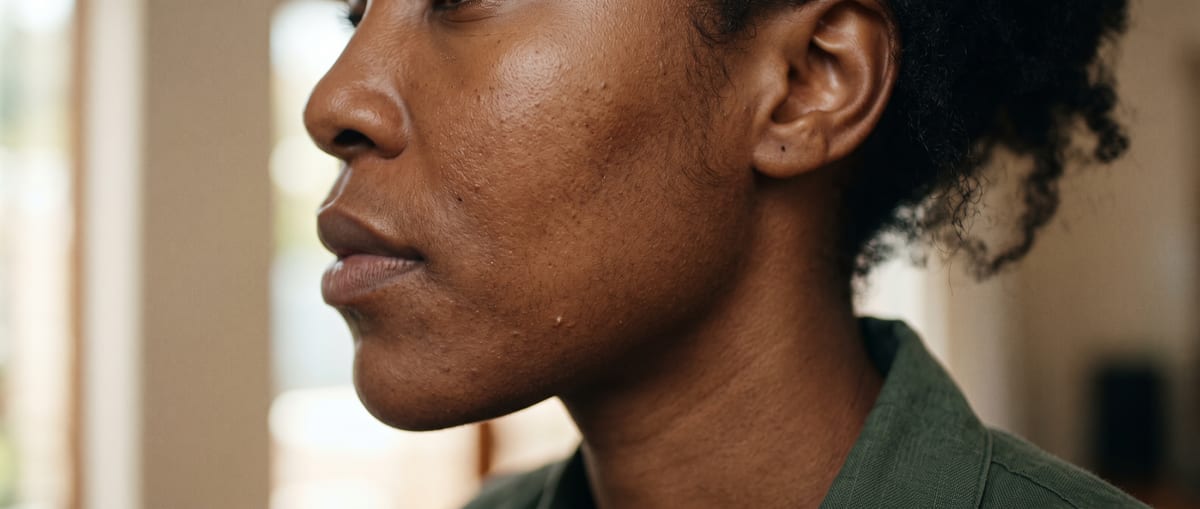
The better the photographs, the more your doctor can tell you. It takes two minutes.
Daylight near a window, not a bathroom light or flash.
One wide photograph showing the whole area, one close-up in focus.
No make-up, no filters, no editing — the marks are the information.
For scalp and hair, part the hair and photograph the scalp directly.
If it has changed, send an older photo of the same spot too.
Clinical honesty
What we cannot do from a photograph.
Remote dermatology is genuinely good at a great many things. It is not good at everything, and we would rather tell you that upfront than take your money for a consultation that cannot help you.
These need a doctor in the room with you
Some things cannot be safely diagnosed from an image. No amount of resolution changes that.
A suspicious or changing mole
A mole that is changing, bleeding, itching or simply looks different from your others. A photograph cannot replace examining the lesion and, where necessary, sampling it.
A rapidly spreading rash with fever
A rash that is spreading quickly, especially alongside fever or feeling genuinely unwell. That combination needs to be seen the same day.
Blistering involving the mouth or eyes
Blistering, peeling or ulceration involving the mouth, eyes or genitals. This is an emergency presentation, not a teleconsultation.
Skin problems in a fragile patient
Any significant skin problem in someone who is very unwell, very young, pregnant, or immune-compromised — the threshold for in-person review is lower.
If your doctor sees any of these, they will tell you plainly and refer you for a physical examination — to a dermatologist, your GP, or an emergency unit, depending on how urgent it is. They will not treat it remotely and hope for the best. Your consultation fee buys you a doctor’s honest clinical judgement, and sometimes that judgement is this needs to be seen in person.
That is not us hedging. It is what a responsible service does.
Know your skin
The ABCDE mole guide
CANSA reports that South Africa has one of the highest skin cancer incidences in the world, second only to Australia. Skin cancer occurs in every skin tone — in darker skin it is often found later, and frequently on the palms, soles and nail beds. Check your moles, and if one ticks any of these boxes, have it looked at in person.
A
Asymmetry
One half does not match the other.
B
Border
Edges that are ragged, notched or blurred.
C
Colour
More than one colour, or uneven shading.
D
Diameter
Larger than 6 mm — about a pencil rubber.
E
Evolving
Changing in size, shape, colour or sensation.
Educational guidance only. The ABCDE guide is a prompt to seek examination, not a diagnosis. Source for South African skin cancer incidence: CANSA (Cancer Association of South Africa).
Get an honest opinion on what you are seeing
HPCSA-registered providers · fee shown before you book · referral if that is the safer call
Start the AssessmentTaken seriously here
Pigmentation and traction alopecia are not minor complaints.
Hyperpigmentation, melasma and traction alopecia affect people with darker skin disproportionately, and they are among the conditions most often waved away as minor. They are not. They are dermatological conditions with identifiable causes, and they respond to a plan.
Traction alopecia — hair loss caused by sustained tension on the hair from styling, braids, weaves or extensions — is strikingly common. Khumalo and colleagues, writing in the Journal of the American Academy of Dermatology in 2008, found it in roughly one in three African women surveyed in South Africa.
Timing matters more here than almost anywhere else in dermatology. Caught early, traction alopecia is largely reversible. Once the follicle scars, the loss is permanent.
Pigmentation assessed by cause, not treated as one thing.
Realistic timelines — months, not days. We will tell you what to expect.
Daily sun protection is part of every pigmentation plan, in every skin tone.
Styling and tension reviewed honestly, without lecturing you about your hair.
Source: Khumalo NP et al., Journal of the American Academy of Dermatology, 2008.

Who is treating you
Real, registered South African practitioners.
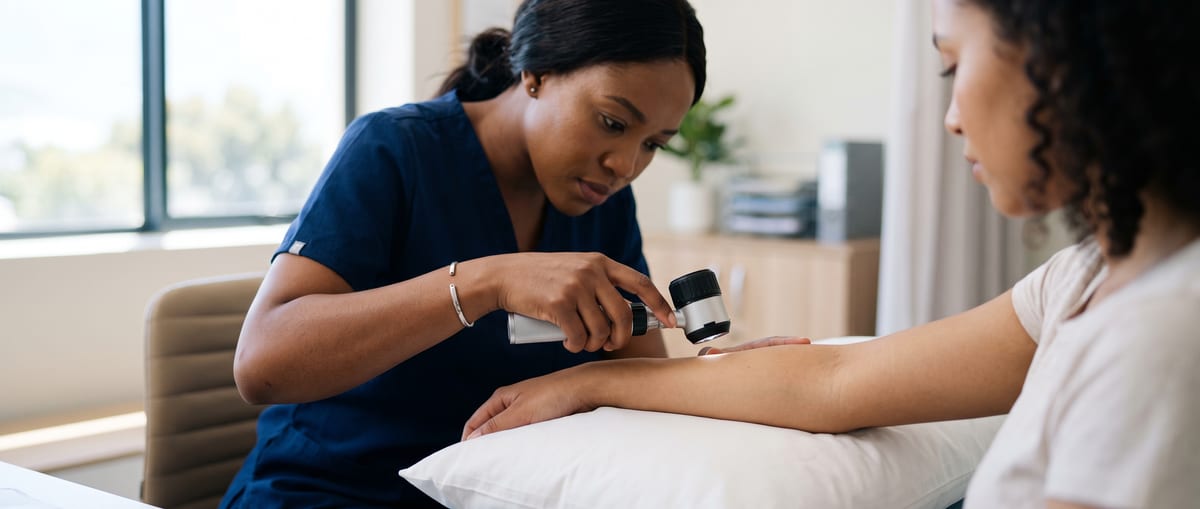
Our skin and hair care team is made up of HPCSA-registered Medical Doctors and Clinical Associates working under live doctor supervision, in line with HPCSA Notice 1390 of 2016. Where a case needs specialist input, we refer you to a registered dermatologist. You will always see who is consulting you before your call begins.
Diagnosis before treatment, every time.
Only SAHPRA-approved medicines, prescribed when clinically indicated.
Dermatologist referral where clinically indicated.
Follow-up built in, so we can tell whether the plan is working.
Start with your history and a few photographs
POPIA compliant · encrypted · available across South Africa
Start the AssessmentCost & cover
Skin and hair care that people can actually reach.
Specialist dermatology waiting lists in South Africa are long, and for many people that means going untreated for months. Fixed, transparent pricing — medical aid or self-pay.
* Cover varies by scheme, plan and benefit year. Confirm with your scheme directly.
What a consultation costs
From R299 with a clinical associate; each doctor sets their own fee, shown before you book.
Medicines, where clinically indicated, are prescribed separately and dispensed by your pharmacy at their own price. Your doctor will tell you before anything is prescribed.
You are in safe hands
Built on trust. Regulated for safety.
Qualified SA practitioners
Every practitioner on iScript Health is registered with the Health Professions Council of South Africa and practises within their full scope.
Your photographs are protected
Clinical photographs and health data are encrypted, stored securely under the Protection of Personal Information Act, and never shared without your consent.
Safe prescribing
Only SAHPRA-approved medicines, prescribed only when clinically indicated, after your full history and current medicines have been reviewed.
FAQ
Frequently asked questions
Still unsure whether this is right for your situation? Start the assessment — if your doctor believes it needs an in-person examination, they will tell you that directly.
Start the conversation
You should not have to wait six months
to be told what is on your skin.
Answer a few questions, upload your photographs, and speak to an HPCSA-registered South African doctor. An honest assessment — including an honest referral if that is what you need.
Start the Skin & Hair AssessmentHPCSA-registered practitioners · POPIA compliant · Available across South Africa